Splendid Natural Dominican Clear Yellow Amber Polished Stone Fossil Insect Bug
Details
Make an Offer
Description
Splendid Natural Dominican Clear Yellow Amber Polished Stone Fossil Insect Bug vegetable 32mm
Stone size: 32x24x10mm
Weight: 5g | 25carats
Certificate included: yes
Clearness: CLEAR
Stone Color: YELLOW
Stone: AMBER
Origin: DOMINICAN REPUBLIC
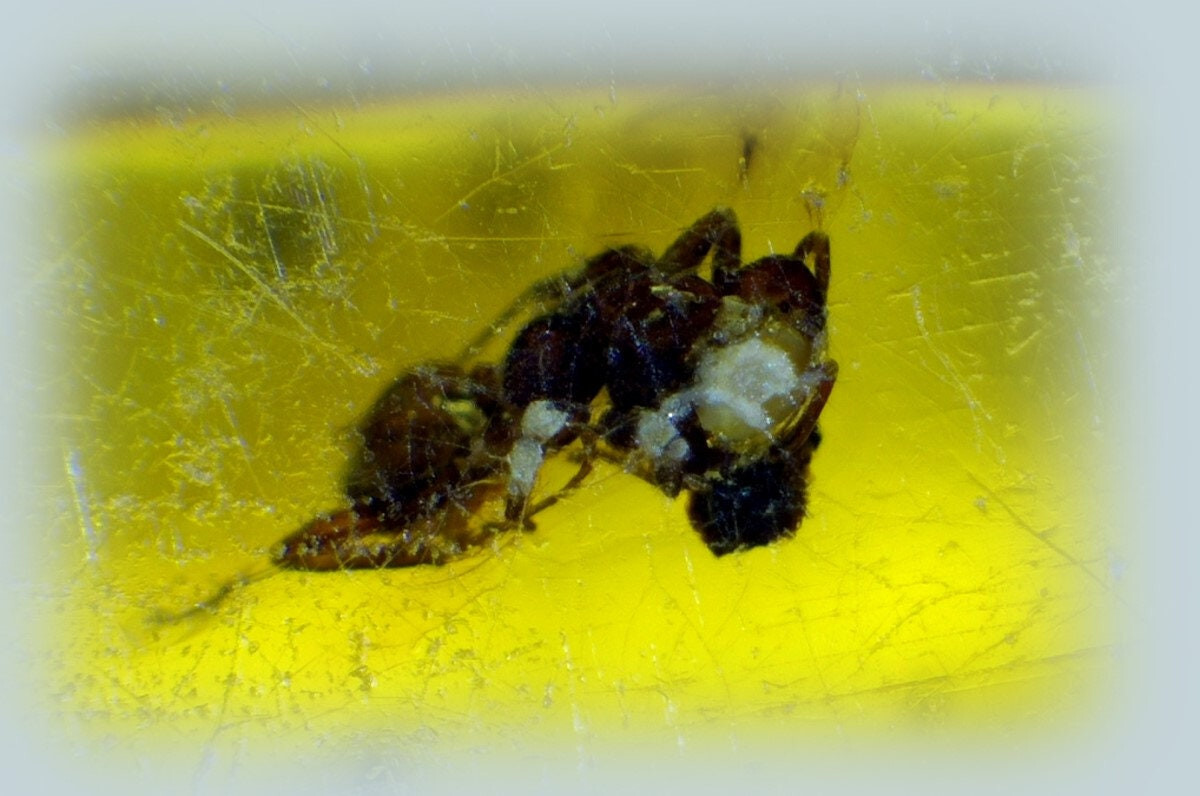
🐜 About the Insect Inclusion 1
This specimen appears to be a small ant or wasp from the order Hymenoptera. The body structure — segmented thorax, narrow waist (petiole), and compact abdomen — strongly suggests a worker ant (family Formicidae) or a tiny parasitic wasp (superfamily Chalcidoidea). Both types are common but scientifically significant inclusions in Dominican amber, which dates back to the Miocene epoch (approximately 15–20 million years ago).
🔍 Visible Features:
-
Segmented body divided into head, thorax, and abdomen — characteristic of Hymenopterans.
-
Strong mandibles (jaws) visible near the head, typical of worker ants.
-
Compact, folded legs tucked close to the body, suggesting the insect was caught mid-movement.
-
Amber clarity is excellent despite surface stress cracks, which do not affect the inclusion’s visibility.
-
Reddish-brown coloration — natural pigmentation preserved over millions of years.
🧬 Scientific Significance:
Ants and parasitic wasps were crucial to Miocene ecosystems, serving as predators, scavengers, and regulators of insect populations. Their presence in Dominican amber helps paleontologists reconstruct:
-
The structure of ancient forest communities,
-
The evolutionary relationships of Hymenopteran species, and
-
The behavioral adaptations (such as colony organization or parasitism) that existed millions of years ago.
This specimen’s preservation — with the abdomen and head still intact — makes it valuable for microscopic examination and identification at the genus or even species level.
🌴 Paleoenvironment:
The insect lived in a lush tropical rainforest on ancient Hispaniola (modern Dominican Republic), surrounded by flowering trees that produced sticky resin. When trapped, the resin rapidly encapsulated the body, protecting it from decay and fossilizing it into amber — a natural time capsule of prehistoric life.
🐛 About the Inclusion 2
The inclusion appears to be a fossilized insect cocoon, larval case, or pupa, encased in clear golden amber. These forms represent an important but relatively rare stage of preservation, offering insight into insect metamorphosis millions of years ago.
🔍 Visible Characteristics:
-
Elongated, oval shape, typical of insect cocoons or pupal cases.
-
Rough surface texture, suggesting it may be covered in fine debris, silk fibers, or organic material once spun by the larva.
-
Curved outline and slight segmentation visible through the amber.
-
The color and opacity suggest partial organic decay before full encapsulation.
🧬 Scientific Interpretation:
This could represent:
-
A Lepidoptera (moth or butterfly) cocoon, spun from silk before pupation.
-
Or a Coleoptera (beetle) pupa, encased in soil or resin near a tree base.
Such inclusions are scientifically valuable because they preserve the developmental stages of insects — evidence of metamorphosis that helps reconstruct the life cycles of ancient species.
They also indicate that the resin flow occurred close to the ground, where larvae often pupated, providing information about the tree’s environment and forest floor conditions.
🌴 Paleoenvironment:
This specimen originated in the Miocene tropical forests of Hispaniola (modern Dominican Republic), approximately 15–20 million years ago. Resin from Hymenaea trees flowed over soil and leaf litter, trapping not only adult insects but also larvae and pupae. Over time, this resin fossilized into amber, preserving the remains in their final developmental stage.
✨ Highlights
🌍 100% natural amber —
no dyes or treatments
🪲 Real insect inclusion (exact piece in
photos)
🇩🇴 Origin: Dominican Republic (Hispaniola)
⏳
Estimated age ≈ 25 million years
💎 Collector’s fossil &
unique jewelry material
📸 Notes
🖼 You will receive the exact
piece shown
💡 Photos taken under natural & macro
lighting
🎨 Colors may vary slightly by screen & light
🛡 Care & Guarantee
🚫 Avoid
chemicals & ultrasonic cleaners
🧽 Clean with a soft cloth
only
📦 Store away from harder stones
✅ We sell only
genuine Dominican amber — satisfaction guaranteed
📝 Note: Age based on geological studies of Dominican amber. Inclusions are exactly as photographed.
Complete Product Specifications
| SKU | C-47-2220 |
|---|---|
| Title | Splendid Natural Dominican Clear Yellow Amber Polished Stone Fossil Insect Bug |
| Country of Origin | Dominican Republic |
| Condition | New |
| Brand | Caribbean Gemstones |
Exact item: The photographs show the exact individual item offered.